
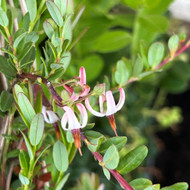
The American Cranberry (Vaccinium macrocarpon) is native to much of eastern coastal areas of Canada and the United States. Cranberries are a low-growing, woody perennial plant – the growth is markedly different to blueberries and lingonberries. Instead of forming a shrub they develop a network of horizontal runners, which can form a dense ‘mat’ and can extend up to 1m in width in ideal conditions. From these horizontal stems, upright branches called (‘laterals’) grow each spring, to a height of about 6-10cm. Flowers then appear on these laterals around May or early June, which when pollinated go on to form the small round fruit, ranging in colour from pale pink to dark red, which ripen in early Autumn. They are extremely decorative when grown in tall pots as their trailing growth hangs over the edges, and the foliage turns beautiful shades of copper and orange in the autumn.
Cranberries are thought to be self-fertile, and whilst wind pollination is thought to play a part, bees are drawn by the sugar-rich nectar and help ensure a good fruit set. Having more than one plant will certainly help with pollination, but there is no need to buy two different varieties.
Blueberries, cranberries and lingonberries are part of the Vaccinium genus, and they belong to the Ericaceae family of heather or heathland plants, which thrive in acidic, well-drained soils. As the ideal pH for all three is between 4.0 and 5.00, it is unlikely that your own soil or a general multi-purpose compost will work. Instead, look for ericaceous compost – most garden centres will stock it – which is specifically formulated for all acid-loving plants such as blueberries, azaleas and rhododendrons. They also like a free-draining, well-aerated soil, so it is a good idea to mix in a little washed sand (it is washed to remove the lime that normal or ‘builders’ sand contains) or composted bark. I tend to use a mix of 60% ericaceous compost, 30% bark and 10% sand.
How to grow:
You may have seen images or adverts of cranberries being picked in flooded fields, but they don't actually need very wet, boggy conditions to thrive. Commercial growers flood their fields both in winter as frost protection and at harvest (the fruit float up to the surface making picking easier), but home growers just need to make sure plants are regularly watered during the summer months, ideally with rainwater. You can use a little tomato feed every month or so from June onwards, but don’t over feed, as this can mean plants produce a lot of new growth but fewer fruit.
As with any plants in containers, drainage is key. Whichever type of pot you use, plastic or terracotta, decorative or functional, make sure there are plenty of drainage holes at the base, add crocks to stop the holes getting blocked and raise the pot off the ground with pot feet or bricks. Cranberries are extremely hardy, they will not thank you for sitting in freezing, waterlogged soil through the winter months. If you live in a hard water area, use rainwater whenever possible (although it goes without saying, in an emergency tap water is better than nothing!)
Varieties to look out for – ‘Early Black’ and ‘Pilgrim’.
Buy Cranberry plants here - Cranberry Plants for Sale | UK Grown Cranberries | RV Roger