
How to combine autumn bulbs
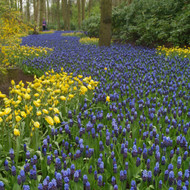
One of the most effective ways to use bulbs is to combine different species according to flowering time, height, colour and form. Rather than thinking of each bulb individually, think about how the planting will develop over several months.
A succession of spring flowers
A simple sequence might be:
Late winter -Crocus: Low-growing and early, crocus provide the first significant splash of colour.
Early spring – Narcissus: Daffodils and narcissus follow with taller stems and larger flowers.
Early–mid spring – Hyacinths: Their strong colours and fragrance add another dimension.
Mid–late spring – Tulips: Tulips provide the main burst of colour.
Late spring–early summer – Alliums: Tall allium flower heads take over as many spring bulbs finish.
This approach can make the garden feel continuously colourful rather than having one short period of bulb flowering.
Combining bulbs with herbaceous perennials
Bulbs don't need to be planted in empty soil. In fact, some of the most successful bulb displays occur when bulbs are planted among established perennials and shrubs. This has several advantages, as early bulbs flower and begin to fade and perennial foliage grows up around them.
This:
- Hides fading bulb foliage
- Provides a more natural appearance
- Extends seasonal interest
- Creates layers of height and texture
- Makes better use of border space
Alliums are particularly effective planted among later-emerging perennials because their flower stems rise above the surrounding foliage.
Using autumn bulbs in borders
When planting bulbs in borders, avoid creating rigid lines unless you are deliberately creating a formal design. For naturalistic planting, use groups and drifts.
A useful approach is to plant:
- Small bulbs in larger numbers
- Medium bulbs in groups
- Large architectural bulbs in repeated clusters
Repeat the same bulb or colour in several areas of the border to create visual continuity.
The rule of repetition
Instead of planting one group of purple tulips in one corner, repeat the colour elsewhere. Likewise, several groups of alliums distributed through a border will usually look more natural and cohesive than one isolated cluster.
How to use autumn bulbs throughout the garden
Bulbs are not restricted to flower borders. They can be integrated throughout the garden to create seasonal transitions.
Under deciduous trees
Plant early bulbs such as crocus and narcissus beneath deciduous trees. These bulbs flower before the tree canopy becomes fully developed, allowing them to take advantage of available spring light.
Around shrubs
Plant bulbs around shrubs to provide colour before and between the shrub's main flowering periods. Small bulbs can occupy spaces close to the front of the planting, while taller tulips and alliums can emerge through the surrounding foliage.
Among roses
Spring bulbs can provide colour before roses begin their main flowering season. Narcissus, tulips and alliums can all work well around roses, with alliums particularly useful for extending the display into late spring.
In herbaceous borders
Use bulbs as seasonal accents among permanent planting. Crocus and narcissus provide early colour, tulips create a major spring display and alliums bridge the gap into early summer.
Along paths
Fragrant hyacinths and colourful narcissus can be planted near paths where they can be seen and enjoyed.
In lawns
Crocus and suitable narcissus can be naturalised through grass for a relaxed spring display. Remember that bulb foliage needs to remain until it has naturally died back, so choose areas where the lawn can be left uncut for an appropriate period.
Designing a naturalistic bulb display
Naturalistic planting doesn't mean simply scattering bulbs randomly.
The best displays usually combine:
- Repetition
- Different heights
- Different flowering times
- Related colours
- Groups of bulbs rather than isolated plants
Try planting bulbs in irregular drifts and repeating those drifts through the garden.
For example:
Crocus → narcissus → tulips → alliums can be repeated through a long border. This creates a visual rhythm as well as a succession of flowers.