
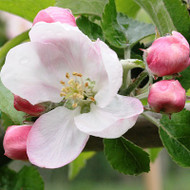
One of the most common questions we hear is, "Do I need two fruit trees to get fruit?" In the next section, we'll explain pollination groups, self-fertile varieties, triploids and how to choose compatible fruit trees to ensure reliable crops year after year.
Pollination Explained – How Fruit Trees Produce Fruit
One of the most common questions we're asked is:
"Do I need two fruit trees to get fruit?"
The answer is sometimes—but not always. And probably less frequently than you think.
Many fruit trees produce heavier and more reliable crops when pollen from one variety is transferred to the flowers of another compatible variety. Others are self-fertile, meaning they can set fruit using their own pollen, making them ideal for smaller gardens where there is only room for a single tree.
Understanding a little about pollination before you buy can make the difference between a tree that flowers beautifully every spring but produces very little fruit, and one that provides abundant harvests year after year.
What is pollination?
Pollination is the process of transferring pollen from the male part of a flower (the anther) to the female part (the stigma). Once pollination has taken place and the flower is successfully fertilised, the fruit begins to develop.
In most gardens, this work is carried out by insects, particularly:
- Honey bees
- Bumblebees
- Solitary bees
- Hoverflies
- Other beneficial pollinating insects
This is why warm, dry spring weather often results in excellent fruit crops, while prolonged cold, wet or windy conditions can reduce pollination activity and lower yields.
Creating a wildlife-friendly garden with flowering plants that attract pollinators benefits not only your fruit trees but the wider garden ecosystem.
Do all fruit trees need a pollination partner?
No. Fruit trees fall into two broad groups: self-fertile and cross-pollinating.
Self-fertile fruit trees
Self-fertile varieties can produce fruit without another compatible tree nearby. They are often the best choice for gardens with limited space or for gardeners planting just one tree.
Many modern cherries and plums are self-fertile, and there are also many self-fertile apples and pears available.
However, even self-fertile trees often produce larger crops and better-quality fruit if another compatible variety is flowering nearby, as additional pollen encourages better fruit set.
Cross-pollinating fruit trees
Many apples and pears require pollen from another compatible variety that flowers at the same time.
This doesn't necessarily mean you need to plant two trees yourself. If neighbouring gardens or nearby orchards contain suitable varieties, they may provide all the pollen your tree needs – bees can transfer pollen from up to 500m away.
In practice, this means that for the vast majority of locations apple tree pollination isn’t an issue – there is almost always another apple or crab tree within 500m or so.
Pears are slightly trickier – there are fewer of them in gardens, and most are not fully self-fertile. If you do not know of a pear tree nearby, finding the room to plant two trees would ensure heavy crops.
Most gages, plums, damsons and quince are self-fertile, so lots of choice if you only want to plant a single tree.
Older, traditional varieties of cherry such as Bigarreau Napoleon are not self-fertile. Thankfully there are several modern varieties which are fully self-fertile, such as Stella and Cherokee.
What are pollination groups?
Fruit tree varieties flower at different times during spring. To help gardeners choose compatible partners, varieties are placed into pollination groups based on their flowering period.
As a general guide:
- Trees in the same pollination group will usually pollinate each other successfully.
- Trees in adjacent groups often overlap enough to be compatible.
- Trees that flower much earlier or later than one another are less likely to provide effective pollination.
Our product pages include pollination information wherever it is relevant, helping you choose suitable combinations with confidence.
What is a triploid apple?
Triploid apples are a fascinating part of fruit growing and often surprise first-time buyers.
These varieties produce exceptionally vigorous trees and are renowned for their large, flavoursome fruit. However, their pollen is generally not fertile, meaning they cannot pollinate other apple trees.
If you're considering a triploid apple, it's worth checking that suitable pollination partners are already present or planning to plant additional compatible varieties.
Why is my fruit tree flowering but not producing fruit?
A tree covered in blossom but carrying little or no fruit is a common disappointment, particularly with younger trees.
There are several possible reasons.
The tree is still immature
Many newly planted fruit trees spend their first few years establishing roots rather than producing heavy crops.
The rootstock plays an important role here. Trees on dwarfing rootstocks usually begin fruiting sooner than those grown on vigorous orchard rootstocks.
Patience is often rewarded.
Poor pollination
If insect activity is low during flowering, or if there is no compatible pollinating variety nearby, many flowers may fail to develop into fruit.
This is particularly noticeable during cold, wet springs when bees remain inactive.
Blossom frost
Late spring frosts are one of the biggest challenges for UK fruit growers.
Although established trees are extremely hardy, their delicate blossom can be damaged if temperatures fall below freezing after flowering has begun.
Damaged flowers may never develop into fruit, even though the tree itself remains perfectly healthy.
Choosing a site away from frost pockets and avoiding low-lying ground where cold air settles can greatly reduce this risk.
Excessive pruning
Removing too much fruiting wood, especially on apples and pears, may reduce flowering the following season.
Different varieties produce fruit in different ways, which is why understanding spur-bearing and tip-bearing varieties becomes important when pruning.
We'll look at this in the next section.
Biennial bearing
Some fruit trees naturally produce a heavy crop one year followed by a much lighter crop the next. This is known as biennial bearing or alternate bearing.
After investing so much energy into producing a large harvest, the tree has fewer resources available to develop flower buds for the following season.
This tendency can often be reduced by thinning heavy crops during early summer, allowing the tree to balance its energy more evenly from year to year.
Can ornamental crab apples help?
Yes.
Many ornamental crab apples produce abundant blossom and excellent pollen, making them valuable pollination partners for dessert and cooking apples.
As well as improving pollination, they provide attractive spring flowers, colourful autumn fruit and excellent wildlife value.
They're a particularly useful choice where garden space is limited but pollination needs to be improved.
How can I encourage better pollination?
There are several simple ways to improve fruit set:
- Choose compatible varieties before planting.
- Include flowering plants that attract bees and other pollinating insects.
- Avoid using insecticides when trees are in blossom.
- Provide a sheltered site where insects can forage easily.
- Plant more than one compatible variety if space allows.
- Consider adding an ornamental crab apple if suitable.
Healthy pollinator populations benefit not only fruit trees but the entire garden.
RV Roger's advice on pollination
Pollination can seem complicated at first, but it doesn't need to be. If you're planting a single tree, choosing a self-fertile variety is often the simplest solution. If you're planning several trees or establishing an orchard, selecting compatible pollination partners from the outset will reward you with heavier crops for many years.
If you're unsure which varieties work well together, we're always happy to help you choose combinations suited to your garden, your location and the fruit you'd like to grow.